Transforming Slicing Efficiency with Automated Food Processing Machinery
Executive Summary
A prominent manufacturer of convenience foods, including sushi, bento bowls, and salads, experienced high labour costs and inconsistent product quality due to manual vegetable slicing. Lingwood Food Services supplied a Kronen GS10-2 Belt Slicing Machine on a trial basis to automate their ingredient preparation. The successful integration of this industrial food processing equipment resulted in a significant return on investment (ROI), improved product consistency, and substantial labour savings, prompting the client to invest in further food processing automation.
Introduction
Lingwood Food Services has been supplying industrial food processing machinery and consultancy since 1996. Proudly representing 11 major manufacturers, Lingwood delivers high-quality, complete solutions to process products in the most efficient and cost-effective way.
Our client, a high-volume producer of convenience foods such as sushi, bento bowls, poke bowls, and salads, required a robust commercial food slicer to process their fresh vegetable ingredients. In the competitive food manufacturing sector, producing visually appealing and consistently sized ingredients is vital. It ensures streamlined assembly on the production line and maintains the strict quality standards that consumers expect from premium ready-to-eat products.
The Challenge: Operational Inefficiencies
Prior to consulting Lingwood, the client faced significant operational challenges within their preparation department. They relied on an existing, imported belt slicer that proved to be highly unreliable and prone to breaking down. When operational, this machinery delivered inconsistent cut quality, which directly compromised the appearance and standard of the final salads and bowls.
To compensate for the machinery’s lack of reliability and to maintain production targets, the client processed ingredients manually. At peak times, they employed up to 26 staff members dedicated solely to cutting peppers, spring onions, and other vegetables by hand.
This highly manual approach created several critical pain points:
- Unsustainable Labour Costs: With current wage rates, employing dozens of staff for repetitive manual cutting was extremely expensive and highly inefficient.
- Inconsistent Product Quality: Hand-cutting leads to variations in the shape and size of the products. This lack of uniformity hindered the manufacturing process, making portion control difficult and reducing the visual appeal of the finished products.
- Production Inefficiencies: The unreliability of the existing machinery meant production schedules were frequently disrupted, causing bottlenecks in the wider manufacturing workflow.
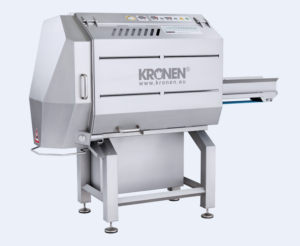
The Solution: Kronen GS10-2 Belt Slicing Machine
Recognising the need for an efficient, reliable, and automated slicing solution, Lingwood recommended the Kronen GS10-2 Belt Slicing Machine. As a recognised worldwide specialist in fresh produce processing equipment, Kronen manufactures machinery renowned for precision, durability, and hygiene.
To ensure the client was completely confident in their investment, Lingwood provided the Kronen GS10-2 on a ‘sale or return’ basis. This allowed the manufacturer to trial the equipment firsthand and understand the integration process before making a final financial commitment.
The Kronen GS10-2 was seamlessly integrated into the client’s production line, specifically configured for slicing delicate ingredients like peppers and spring onions. The machine is engineered to deliver precise, clean cuts, ensuring that every piece of produce is processed to the exact specifications required for the client’s diverse range of convenience foods. As part of Lingwood’s standard service, full installation and staff training were provided, backed by a commitment to lifetime technical support.
Take a look at our Kronen product brochure.
The Results: ROI and Operational Excellence
The implementation of the Kronen GS10-2 Belt Slicing Machine delivered immediate, measurable improvements across the client’s production facility.
The most significant outcome was the substantial Return on Investment (ROI) driven by the reduction in manual labour. By automating the slicing process, the client redeployed 26 staff members from manual hand-cutting to other areas of the business. This shift toward automation streamlined the process, significantly improving efficiency. Based on current wage rates, the ability to reallocate staff resources generated substantial operational savings, contributing to an exceptionally quick payback period.
In addition to the financial savings, the operational results included:
- Superior Product Quality: The Kronen machine delivered precise, uniform cuts, vastly improving the appearance and consistency of the peppers and spring onions.
- Optimised Manufacturing: Consistent ingredient sizing aided the downstream assembly process, allowing for accurate portioning and a uniform finished product for the end consumer.
- Increased Reliability: The robust design of the Kronen GS10-2 eliminated the downtime previously caused by the unreliable legacy equipment.
Conclusion
By replacing an inefficient manual process with the industry-leading Kronen GS10-2 Belt Slicing Machine, the client successfully transformed their production line. They drastically reduced their operational costs while simultaneously elevating the quality and consistency of their final products.
This project perfectly demonstrates Lingwood’s commitment to providing tailored, cost-effective solutions and lifelong support to the food manufacturing industry. Following the outstanding results of this initial installation, the client has since committed to a wider partnership with Lingwood, placing orders for additional industrial food processing machinery, including automated washing, drying, and dicing equipment.